


“Transforming Learning Spaces with Intelligent AV"
In recent years, the convergence of Artificial Intelligence (AI) and Audio-Visual (AV) technology has ushered a ground breaking phase of innovation in education. These developments are not merely improving teaching and learning methodologies; they are fundamentally reshaping educational settings.
Here’s how AI-driven AV technology is revolutionizing the classroom experience.
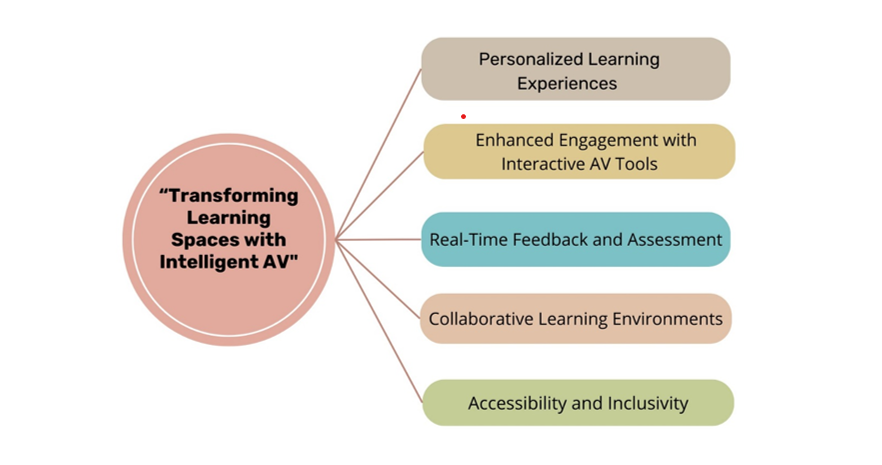
1. Personalized Learning Experiences
- One of the most significant impacts of AI-driven AV technology in education is the ability to create personalized learning experiences.
- This personalization ensures that each student receives the right level of challenge and support, making learning more effective and engaging.
2. Enhanced Engagement with Interactive AV Tools
- Interactive AV tools, powered by AI, are making lessons more engaging and interactive.
- Smart whiteboards, AR/VR applications, and AI-driven presentation software are bringing subjects to life, allowing students to interact with content in ways that were previously unimaginable.
3. Real-Time Feedback and Assessment
- AI-driven AV technology enables educators to provide real-time feedback and assessments, which is crucial for effective learning.
- AI tools can automatically grade assignments, quizzes, and even complex projects, providing instant feedback to students.
- This not only saves time for educators but also helps students understand their mistakes and learn more efficiently.
4. Collaborative Learning Environments
- AI-driven AV technology facilitates collaborative learning by connecting students and educators in new and meaningful ways.
- Video conferencing tools with AI capabilities, such as automated transcription, real-time language translation, and facial recognition for attendance, make remote learning and collaboration seamless.
5. Accessibility and Inclusivity
- AI-driven AV technology is also making education more accessible and inclusive.
- AI tools can assist students with disabilities by providing real-time subtitles, sign language interpretation, and text-to-speech capabilities.
- This ensures that all students, regardless of their abilities, have equal access to educational content.
6. The Future of AI-Driven AV in Education
- AI-driven AV technology is also making education more accessible and inclusive.
- AI tools can assist students with disabilities by providing real-time subtitles, sign language interpretation, and text-to-speech capabilities.
- This ensures that all students, regardless of their abilities, have equal access to educational content.
The Future of AI-Driven AV in Education
- The integration of AI-driven AV technology in education is still in its early stages, but the potential is immense.
- As these technologies continue to evolve, we can expect even more innovative solutions that will further transform educational environments.
- From intelligent tutoring systems to advanced analytics that predict student success, the future of education is set to be more dynamic, personalized, and inclusive than ever before.
Conclusion
- AI-driven AV technology is not just a trend but a fundamental shift in how education is delivered and experienced.
- By creating personalized learning experiences, enhancing engagement, providing real-time feedback, fostering collaboration, and ensuring accessibility, these technologies are transforming educational environments for the better.
- As we continue to explore and embrace these advancements, the possibilities for improving education are endless.